
Festive savings, handcrafted for you


Chandrakalakriti
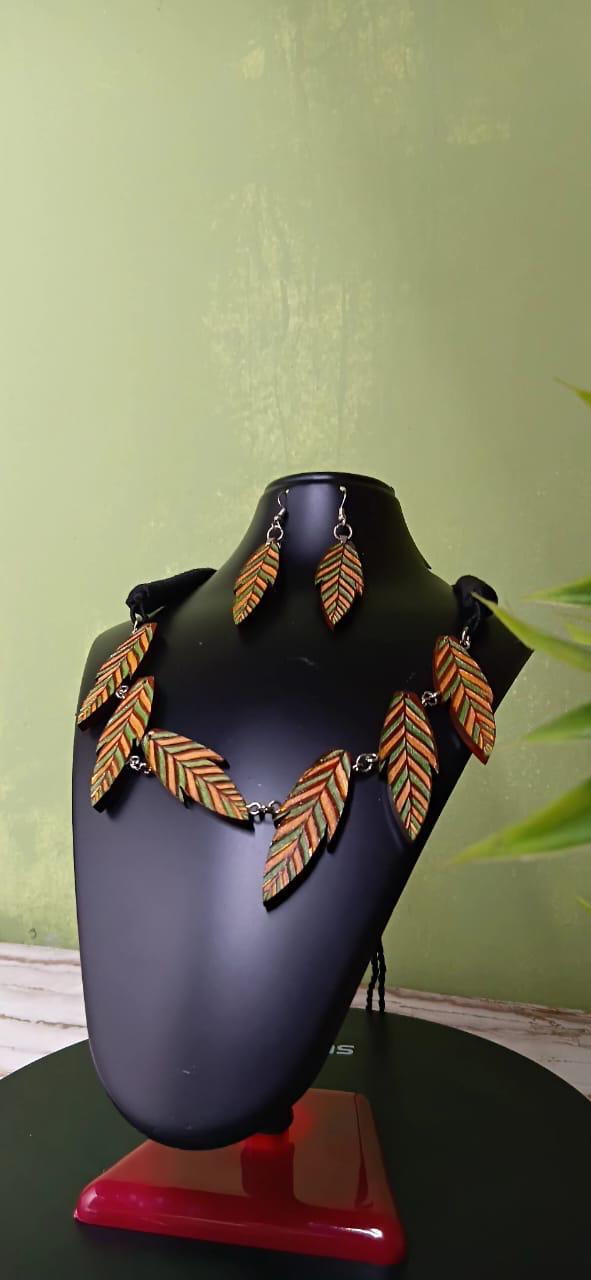
Kisalaya Wooden Jewellery Set – Yellow & Green Carved Boxwood Leaf Necklace with Earrings
Kisalaya Wooden Jewellery Set – Yellow & Green Carved Boxwood Leaf Necklace with Earrings
Couldn't load pickup availability
🔁
Returns & Exchange
Damaged, defective or wrong item? Report it within 48 hours of delivery with an unboxing video and we'll make it right.
▾
📹 Film your unboxing. Start recording before you open the parcel. We can't process a damage, missing-item or wrong-item claim without the video.
💬 Tell us within 48 hours. Send the video and photos on WhatsApp to +91 98301 50088 or by email to reachchandrakalakriti@gmail.com.
📦 We arrange the return. Reverse pickup where available, free for damaged, defective or wrong items. Items must be unused and in their original packaging.
💳 Refunds go back to your original payment method within 7–10 business days of approval. Exchanges are subject to stock.
✋ Every piece is handcrafted, so we can't accept returns for a change of mind.
Seven carved Boxwood leaves in yellow and green, with the matching pair at the ear — the veins cut into the wood by hand and the colour laid inside the cuts.
Kisalaya is the Sanskrit word for the tender new leaf, the one that opens yellow-green before it matures into anything darker. It is the exact state these leaves are caught in, which is why the set carries the name.
Each leaf is 5 cm long with a midrib running its full length and veins branching off on both sides. Every one of those veins is a channel cut into the pale Boxwood, and the yellow and green sit down inside them rather than on top.
Two colours in one cut line
Most carved-and-filled work takes a single colour. This takes two, worked into the same cuts, so the veining shifts in tone as it travels out from the midrib instead of reading as one flat note.
That is what gives a small piece its depth. A leaf is not one colour in life either — it is a gradient, and a single filled line cannot suggest that. Two can.
It also means nothing here is a surface layer. Colour held in a cut channel has no exposed edge, so there is nothing standing proud to wear thin at the places a necklace gets handled. Run a finger across a leaf and you feel wood, level the whole way.
Why colour is the hard part, not the carving
This is the thing worth understanding about a set like this, and it is not the obvious one.
Carving the veins is skilled, but it is a known problem — a midrib, branches at an angle, cut cleanly, done. The difficulty arrives with the second colour, and it multiplies with every piece added.
On a single pair, the yellow-to-green transition has to land at the same point on two leaves. Here it has to land at the same point on nine: seven across the collarbone and one at each ear. A leaf where the colour turns a few millimetres early or late is not a carving fault — the carving can be flawless — but laid in a row beside its neighbours, the eye picks it out immediately as a break in the run.
One colour is forgiving across a row of pieces. Two is not. And because the carving has to be finished before any colour goes in, and a cut cannot be undone, the registration has to be planned before the first vein is made rather than corrected afterwards.
The only coloured set we make
Everything else in our set range is bare wood, or wood with a single dark line through it. This is the one with colour in it, and that changes what it is for.
A bare-wood set is a neutral — it goes with almost anything and asks very little. Kisalaya is not a neutral. It has a palette of its own, and it belongs with fabrics that agree with that palette rather than with everything in the wardrobe. That is a narrower job, but it is a job none of the others can do: it is the set to wear when an outfit needs something warm near the face rather than something quiet.
How the necklace is built
Seven leaves, all the same size, linked with metal rings so the run follows the curve of the neckline on its own. There is no larger centre leaf — each one carries the same carving and the same two colours as the piece beside it.
The cord is black cotton thread, not leather, and it adjusts: a cotton bead slides along the thread passing through it, so you set the length and it stays. Black is the right cord here precisely because it is not a third colour — it holds the leaves without joining the conversation.
The earrings
A single carved leaf on a hook at each ear — the same design we sell on its own as Ankhia Wooden Earrings, at the same 5 cm as the leaves on the necklace. Matching them exactly is the point: with seven of one leaf across the collarbone, a different shape at the ear would end the run rather than extend it.
▾Details
- Sold as: one pair of earrings and one necklace
- Shape: a leaf tapering to a point, with a carved midrib and veins branching on both sides
- Body: Boxwood, pale and close-grained, undyed
- Surface: veining carved into the wood by hand and filled with yellow and green — cut in, not painted on
- Necklace: seven leaves linked with metal rings, all the same size, with no larger centre piece
- Earrings: one leaf on a metal alloy hook
- Size: every leaf is 5 cm long, on the necklace and at the ear
- Cord: black cotton thread, adjustable — a sliding cotton bead sets the length
- Findings: metal alloy hooks and rings
- Earrings weight: 10 g the pair
- Made in: India, from responsibly repurposed exotic hardwood, handcrafted by skilled artisans
Why Boxwood takes carved colour
Boxwood is dense and close-grained almost to the point of having no visible figure, and that matters twice over here.
First, a tight grain lets a cutting tool go where it is pushed rather than following the wood, which is what keeps a vein branching at the angle it was meant to. An open-grained timber would tear at those fine branches and leave them ragged.
Second, a close grain holds colour where it is put. On an open-grained wood the fill would wick along the grain and blur the edge of every line; on Boxwood the cut line stays a line. The pale ground also means the yellow reads as yellow rather than being pulled brown by the wood underneath it.
How to style the Kisalaya set
This is the one set in the range to style by colour rather than by pattern.
- Natural and earth tones: its best company — olive, mustard, moss, rust, ochre, and anything in the undyed-cotton family
- Cream, off-white and beige: the cleanest backdrop of all, because the leaves become the only colour in the look
- Bottle green and indigo: deep grounds that let the yellow lift away from the fabric
- Plain cottons, linen and khadi: the right weight of cloth for it — a daytime set rather than an evening one
- Necklines: open or V, so the full run of seven can be read end to end
What to avoid is a strong pink, magenta or scarlet. Those sit on the opposite side of the wheel from a yellow-green leaf and the two will fight rather than flatter. And as with any carved set, keep the blouse neckline plain — embroidery there competes directly with seven carved leaves lying across it. If your saree is heavily worked, wear Shashi or Jyotsna instead and save this one for a plain drape.
▾Care
- Put the set on after perfume, makeup and skincare have settled — the necklace sits where perfume is usually heaviest, and alcohol is the one thing that troubles a filled line
- Take it off before bathing, swimming or exercising. Cotton thread holds damp far longer than wood does
- Wipe the wood gently with a soft, dry cloth after each wear
- If the carved veins collect dust, lift it out with a dry, soft-bristled brush rather than picking at the lines
- Store flat in the box or pouch provided, away from moisture, heat and direct sunlight — flat storage keeps the linked leaves from twisting on their rings
- Handle the earrings by the metal findings and the necklace by the cord rather than the wooden leaves
▾Shipping & returns
Dispatched within 2–3 working days. Free shipping on prepaid orders within India; delivery is typically 2–3 days to metro cities and 5–7 days elsewhere in India. Cash on Delivery is available at selected locations with a ₹50 cash-handling charge.
The Kisalaya set ships worldwide, arriving within 5–10 days of your order — import duties and local taxes are payable by the recipient.
Returns within 48 hours of delivery for damaged, defective or incorrect items. Please film an unboxing video — it is required for any such claim. Message us on WhatsApp at +91 98301 50088 or email reachchandrakalakriti@gmail.com and we will arrange a free reverse pickup.
Frequently asked questions
▾What is included in the Kisalaya set?
One pair of earrings and one necklace. The necklace carries seven carved Boxwood leaves; the earrings are one leaf each. Every leaf is carved with a midrib and branching veins and filled with yellow and green.
▾What does Kisalaya mean?
The tender new leaf, in Sanskrit — a leaf at the stage where it is still yellow-green and has not darkened. It is the state these leaves are carved and coloured to show.
▾How big are the leaves?
Every leaf is 5 cm long — the seven on the necklace and the one at each ear are all the same size, with no larger centre piece.
▾Is the colour painted on or carved in?
Carved in, then filled. The midrib and veins are cut into the Boxwood by hand first, and the yellow and green are worked down into those channels. The colour sits below the surface of the wood, not on top of it.
▾Will the colour wear off?
No. Because the colour lies inside a cut channel it has no exposed edge to rub away at the points a piece gets handled. It is the same principle as inlay, with colour in place of a second wood.
▾Why two colours instead of one?
Because a leaf is not one colour. Yellow and green worked into the same cut lines let the veining shift in tone as it runs out from the midrib, which gives a small piece depth that a single flat colour cannot.
▾What makes a two-colour set harder to make?
Registration. The point where yellow gives way to green has to land in the same place on all nine pieces — seven on the necklace and one at each ear. A leaf whose colour turns a few millimetres early is not a carving fault, but set beside its neighbours in a row the eye finds it at once. One colour forgives that across a run; two does not.
▾How many leaves are in the necklace?
Seven, linked with metal rings. All seven are the same size and carry the same carving — there is no larger centre leaf.
▾Are the earrings the same as the Ankhia earrings sold on their own?
Yes. The earrings in this set are the same design we sell separately as Ankhia Wooden Earrings. If you already own that pair, you own half of this set.
▾Do the earrings have hooks or push backs?
Hooks. The leaf hangs from a metal alloy hook, which lets it swing and sit a little lower than a post would.
▾What wood is this?
Boxwood throughout. It is dense and close-grained, which keeps a fine carved vein from tearing and stops the fill wicking along the grain and blurring the line. It is responsibly repurposed exotic hardwood.
▾Is the wood itself dyed?
No. The Boxwood is undyed and unstained — its pale tone is the wood's own. The only colour anywhere in the set is what has been filled into the carved lines.
▾Is the necklace adjustable?
Yes. A cotton bead slides along the cord that passes through it, so you set the length yourself and it holds there.
▾What is the cord made of — is it leather?
Black cotton thread, not leather. The adjuster is a cotton bead as well. Black keeps the cord from acting as a third colour against the yellow and green.
▾Is a necklace of seven wooden leaves heavy?
No. Seven linked pieces in metal or stone would be a real weight at the neck; in Boxwood the scale is visual rather than physical. The earrings are 10 g the pair.
▾Which colours does this set go with?
Olive, mustard, moss, rust and ochre sit with it most easily, and cream or off-white gives it the cleanest backdrop. Bottle green and indigo work as deep grounds. Avoid strong pink, magenta and scarlet — those are across the wheel from a yellow-green leaf and the two will fight.
▾How is this different from your other jewellery sets?
It is the only one with colour in it. Every other set we make is bare wood or wood with a single dark line, which makes them neutrals that go with almost anything. This one has a palette of its own, so it is chosen to suit an outfit rather than to disappear beside it.
▾How do I clean the carved lines?
With a dry, soft-bristled brush, which reaches into the channels where a cloth cannot. Do not pick at the lines, and keep water, soap and polish away from them.
▾What if it gets wet?
Dry it straight away with a soft cloth and leave it in open air before storing — the cotton cord takes longer to dry than the wood does. Brief contact is survivable; soaking, swimming and showering are not.
▾What are the findings made of?
Metal alloy — hooks on the earrings and rings linking the leaves of the necklace. The wood itself has no plating or coating. If your skin reacts easily to metal, please write to us before ordering and we will tell you exactly what we know rather than guess.
▾Can I wear the earrings without the necklace?
Yes, and they are the easier half to wear day to day. One carved leaf at the ear brings a little colour to an outfit; seven across the collarbone makes colour the subject of it.
▾Will my set look exactly like the photographs?
The design will match. The grain beneath the carving and the exact run of colour along each vein will not, because the wood differs piece to piece and every line is cut and filled by hand.
Related designs
- Ankhia Wooden Earrings — the earrings from this set, on their own
- Kalpavalli set — seven leaves again, engraved with vine-work in a single colour rather than carved veins in two
- Ahana — the same carved leaf filled in deep navy
- Taru — a carved Boxwood leaf with its veining left in the wood's own colour
- Kalpataru — engraved and filled Boxwood leaf drops
Share

Kisalaya Wooden Jewellery Set – Yellow & Green Carved Boxwood Leaf Necklace with Earrings
Rs. 2,100.00