


Festive savings, handcrafted for you


Chandrakalakriti
Taru Wooden Earrings – Hand-Carved Boxwood Leaf Drop Earrings
Taru Wooden Earrings – Hand-Carved Boxwood Leaf Drop Earrings
Couldn't load pickup availability
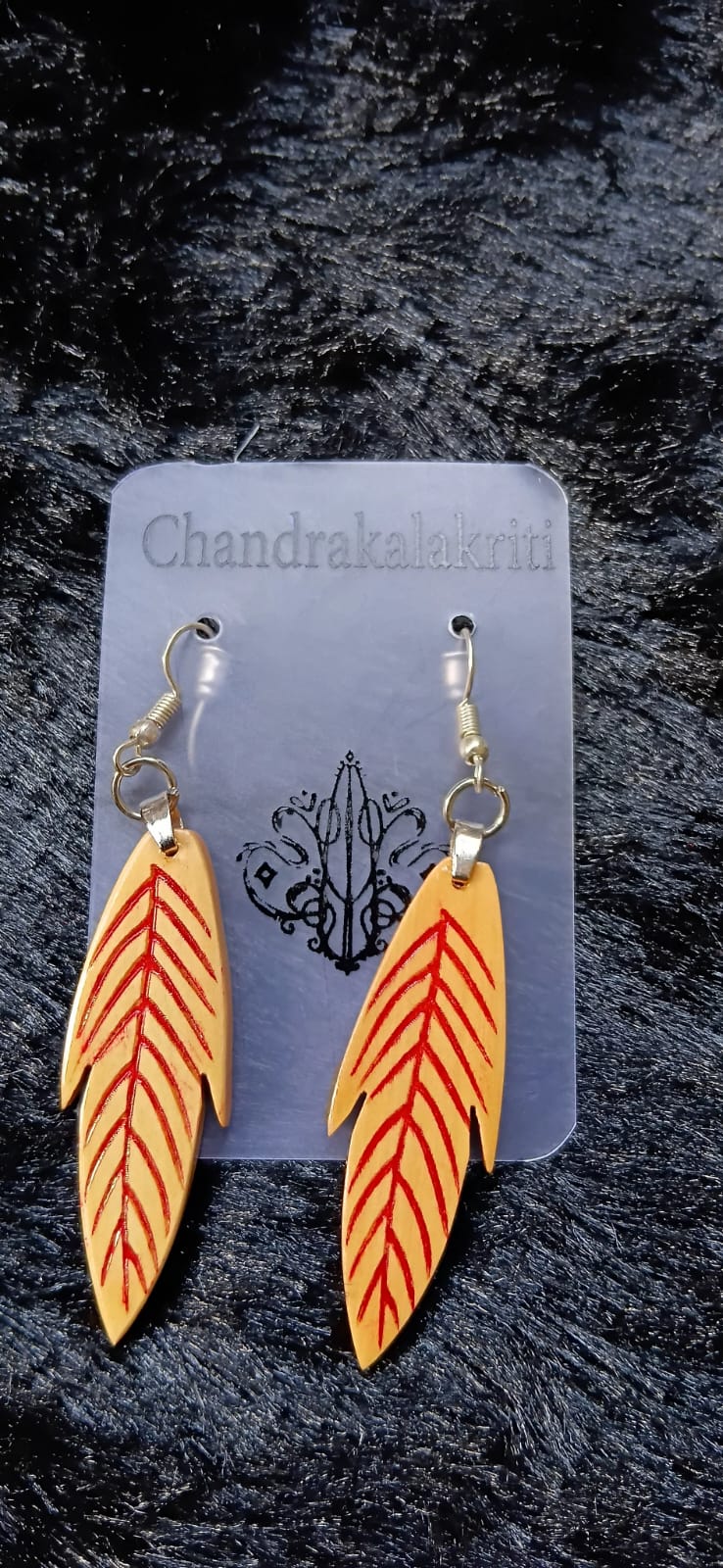
A long Boxwood leaf, notched at the edges, its veining carved into the surface by hand and then filled with red.
Taru is the Sanskrit word for a tree. The form follows it exactly: a slender leaf, tapering to a point, with two small notches cut into each side so the silhouette breaks like a frond rather than sitting as a smooth oval.
Cut first, then coloured
The red veining on Taru is not painted onto the surface. Each line is carved into the wood first — a midrib running the full length of the leaf, with angled veins branching off it on both sides — and the colour is then worked down into those incised channels.
It is the same logic as inlay, with pigment in place of a second wood. And it matters for a practical reason: because the colour sits below the surface plane rather than on top of it, there is nothing raised for daily wear to rub against. Surface paint sits proud and eventually abrades. Colour held in a cut channel does not.
It is also two operations rather than one. The carving has to be right first, because a cut cannot be undone — and only then does the colour go in. Cutting a vein that runs the entire length of a leaf is the unforgiving version of this work: there is no short stroke to hide a wobble in, and the line has to stay true from the crown all the way to the tip.
Why Boxwood
Boxwood is pale, dense and exceptionally close-grained — historically the wood carvers reached for when they needed fine detail to hold. That tight grain is what lets a channel this narrow be cut cleanly without the fibres tearing, and what keeps the colour crisp inside it instead of bleeding out along the grain. On an open-grained timber neither would work.
Details
- Wood: Boxwood, responsibly repurposed
- Craft technique: hand-shaped, hand-carved veining, then colour filled by hand
- Design: a long leaf form with notched edges and carved red veining
- Findings: metal alloy hooks with a metal bail
- Unit: one pair
- Made in: India, carved and finished by hand by skilled artisans
How to style Taru Wooden Earrings
With a saree. Warm gold with red is one of the most natural palettes a saree can take. Taru is at its best against maroon, rust, cream, mustard, olive and off-white — cotton, khadi, linen and handloom drapes especially. The length reads clearly with the hair tied back.
With a kurta. Keep the fabric solid so the veining stays legible. Ivory, ochre, terracotta and indigo all give it room.
With western wear. A white shirt, linen, denim, neutral co-ord sets. The leaf form is soft enough to read as contemporary rather than costume.
For festive days. Red carries Durga Puja, Navratri, Diwali and Poila Boishakh, and this is a long, light piece that can be worn from morning through to evening.
Taru is a long drop. Skip the necklace, wear the hair up or back, and keep other jewellery quiet.
Caring for your Taru Wooden Earrings
- Wipe gently with a soft, dry cloth after every wear. Never wash them.
- Avoid solvents and alcohol-based cleaners, and nothing abrasive across the carved lines.
- Put them on last, once perfume, makeup and skincare have settled.
- Take them off before bathing, swimming or exercising.
- Store in the box or pouch they arrive in, somewhere cool, dry and out of direct sunlight.
- Handle them by the metal findings rather than the face of the leaf.
Frequently asked questions
What wood are Taru Wooden Earrings made from?
Boxwood — a single responsibly repurposed hardwood. It is pale, dense and unusually close-grained, which is exactly what allows a channel this fine to be cut without the fibres tearing.
Is the red veining painted on top of the wood?
No. The veins are carved into the surface first, and the colour is then filled down into those cut channels. The red sits inside the wood rather than on it.
Why does carving and filling last longer than painting?
Because there is nothing raised for wear to catch. Surface paint sits proud of the wood and abrades over time; colour held below the surface in a cut channel has no exposed edge to rub away. It is the same principle as inlay, with pigment instead of a second wood.
What does the name Taru mean?
Taru is the Sanskrit word for a tree. The leaf form is where the name comes from.
What shape is this earring?
A long, slender leaf, tapering to a point at the base, with two small notches cut into each side so the outline breaks like a frond instead of running smooth.
How difficult is the carving?
The midrib runs the entire length of the leaf, which is the hardest kind of line to cut — there is no short stroke to hide an error in, and a cut cannot be undone once made. The angled veins then have to meet it cleanly on both sides.
Will my pair look exactly like the photographs?
The design will match, but the cutting will be its own. Every leaf is carved by hand, so the exact depth and spacing of the veins shift slightly from pair to pair. That variation is the evidence a person made it.
Are these long earrings?
Yes. Taru is one of the longer designs in the range, and it is best worn with the hair tied back or tucked so the full length of the leaf is visible.
Are they heavy?
No. Despite the length, this is a thin, flat piece in a light wood — it weighs a fraction of what a metal earring of the same size would, so there is very little pull on the lobe.
What are the hooks made of?
Metal alloy, with a metal bail joining the hook to the leaf. If your ears react to particular metals, please write to us at reachchandrakalakriti@gmail.com before ordering and we will tell you exactly what we know rather than guess.
Are wooden earrings durable enough for regular wear?
Boxwood is a dense, hard-wearing timber, historically chosen by carvers precisely because it holds fine detail without splitting. Handled with ordinary care — not dropped onto tile, not left sitting in water — Taru is made for repeated wear over years.
Can they get wet?
Please avoid it. Take them off before bathing, swimming or exercising. If they do get damp, dry them at once with a soft cloth and let them air fully before storing.
Do these suit sarees, or western wear too?
Both. The gold-and-red palette sits naturally with cotton, khadi and handloom sarees, while the leaf shape is soft enough to work with a plain white shirt or linen.
How should I clean and store them?
A soft, dry cloth after each wear — nothing wet, nothing abrasive, no solvent of any kind. Store the pair on its own in the box or pouch it arrived in, somewhere cool, dry and away from sunlight.
Are these a good keepsake, and how are they packed?
Yes. Every pair is quality-checked and packed in premium protective packaging, ready to give — a considered keepsake for birthdays, anniversaries, festivals and corporate gifting.
How long does delivery take, and what if the parcel arrives damaged?
Orders are dispatched within 2–3 working days. Inside India, delivery takes 2–3 days to metro cities and 5–7 days elsewhere, and prepaid orders ship free; Cash on Delivery is available at selected locations with a ₹50 cash-handling charge. We ship worldwide, with import duties and local taxes payable by the recipient. Please film an unboxing video when your parcel arrives — if anything is damaged, defective or incorrect, write to us within 48 hours at reachchandrakalakriti@gmail.com with the video and photographs and we will put it right.
Related designs
Share


Taru Wooden Earrings – Hand-Carved Boxwood Leaf Drop Earrings
Rs. 649.00