
Festive savings, handcrafted for you


Chandrakalakriti
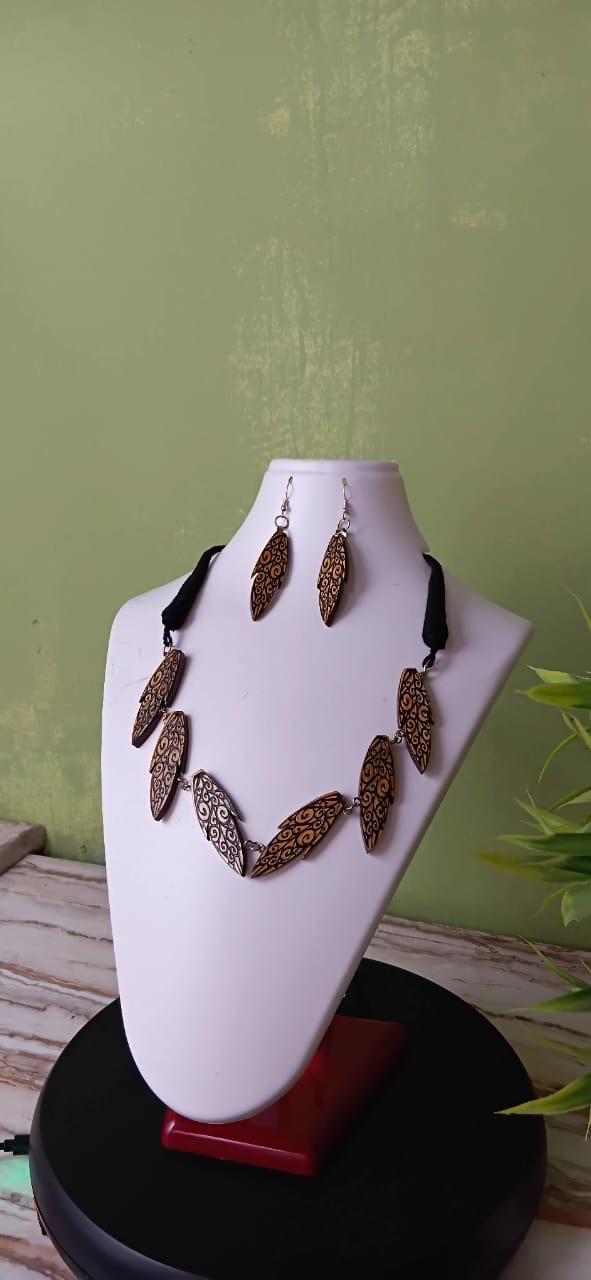
Kalpavalli Wooden Jewellery Set – Engraved & Filled Boxwood Leaf Earrings with Necklace
Kalpavalli Wooden Jewellery Set – Engraved & Filled Boxwood Leaf Earrings with Necklace
Couldn't load pickup availability
🔁
Returns & Exchange
Damaged, defective or wrong item? Report it within 48 hours of delivery with an unboxing video and we'll make it right.
▾
📹 Film your unboxing. Start recording before you open the parcel. We can't process a damage, missing-item or wrong-item claim without the video.
💬 Tell us within 48 hours. Send the video and photos on WhatsApp to +91 98301 50088 or by email to reachchandrakalakriti@gmail.com.
📦 We arrange the return. Reverse pickup where available, free for damaged, defective or wrong items. Items must be unused and in their original packaging.
💳 Refunds go back to your original payment method within 7–10 business days of approval. Exchanges are subject to stock.
✋ Every piece is handcrafted, so we can't accept returns for a change of mind.
Seven engraved Boxwood leaves linked in a run across the collarbone, with the matching pair at the ear — vine-work cut into every one of them by hand.
In Indian tradition the kalpataru is the wish-fulfilling tree. Kalpavalli is the same wish growing as a creeper — a vine rather than a trunk. The distinction is the whole design. Kalpataru puts the vines on a single leaf at each ear; Kalpavalli runs them along seven leaves in a row, so the pattern travels the length of the neckline the way a creeper travels a wall.
The leaf is long and pointed at both ends, and every square millimetre of its face carries scrollwork. There is no plain border and no empty ground — the pattern goes right to the edge.
Seven leaves, and no centrepiece
This is the first thing to notice, and it is deliberate.
Almost every necklace is built around a middle. A pendant, a larger stone, a wider plaque — something that says this is the front and lets everything else taper away from it. Kalpavalli has none. All seven leaves are the same leaf at the same size — 5 cm long — and they are the same size as the drop at your ear.
What holds the centre instead is the pattern itself. Because the vine-work is the subject rather than the shape, it does not need a focal point to read — it needs to be continuous. Seven identical leaves give you that: the scrollwork starts at one end of the cord and arrives at the other without pausing anywhere to announce a middle. The necklace reads as one growing thing rather than as a frame around an ornament.
It also means the set has no wrong way round. Shift the cord as you wear it and nothing is out of place, because no leaf was ever meant to be the one in front.
The pattern is cut in, not laid on
Every line of the vine-work is engraved into the Boxwood first. Colour is then worked down into the cut channels and the surface is levelled back, so the dark scrollwork finishes below the original face of the wood rather than standing on it. Run a finger across a leaf and you feel wood, not pattern.
That matters for how long the set lasts. A design brushed onto a surface is a layer, and layers are what rub thin at the points a piece gets handled — the edges, the back, the places a necklace rests against skin all day. A design that sits in a channel has nothing standing proud to wear away. It is the same reasoning behind inlay, applied to colour instead of to a second wood.
It is also why the colour reads so cleanly against the gold of the Boxwood. The wood's own tone is untouched, deepened only by cutting and polishing; the contrast comes entirely from what is in the cuts.
Why repeating a dense pattern is the hard part
Engraving one leaf well is a known problem. Engraving eight of them — seven on the necklace and one at each ear — so that they look like the same leaf is a different one.
An engraved line is final at the moment it is made. There is no filling it back in and starting again, so every one of the hundreds of curves on a single leaf has to be right first time. Multiply that by eight pieces and the difficulty stops being about any individual line and becomes about consistency of weight: whether the scrolls on leaf four are the same size, spaced the same way and cut to the same depth as the scrolls on leaf one.
Get that wrong and the eye finds it instantly, even though it could not tell you why. One leaf cut slightly more openly than its neighbours reads as a gap in the pattern; one cut more tightly reads as a smudge. On a piece where the pattern is the whole design, the pattern has to arrive at the same density every single time — which is a steadier kind of skill than making one beautiful thing.
How the necklace is built
Seven leaves joined end to end with metal rings, so the run follows the curve of the neckline on its own rather than being forced into a shape.
The cord is black cotton thread, not leather, and it adjusts: a cotton bead slides along the thread passing through it, so you set the length yourself and it stays where you put it. Black against the honey of the engraved Boxwood is the strongest contrast available, and it keeps the eye on the leaves rather than on what is holding them.
The earrings
A single engraved leaf on a hook at each ear — the same design we sell on its own as Kalpataru Wooden Earrings, and the same size as the leaves on the necklace. Keeping them identical is the point. With seven of the same leaf across the collarbone, a different shape at the ear would break the run; the same shape extends it.
▾Details
- Sold as: one pair of earrings and one necklace
- Shape: a long leaf, pointed at both ends
- Body: Boxwood — naturally pale honey gold, deepened by cutting and polishing
- Surface: hand-engraved vine-work with colour filled into the cut lines and levelled flush
- Necklace: seven leaves linked end to end with metal rings — all the same size, with no larger centre piece
- Earrings: one leaf on a metal alloy hook
- Size: every leaf is 5 cm long — the seven on the necklace and the one at each ear are all the same size
- Cord: black cotton thread, adjustable — a sliding cotton bead sets the length
- Findings: metal alloy hooks and rings
- Earrings weight: 10 g the pair
- Made in: India, from responsibly repurposed exotic hardwood, handcrafted by skilled artisans
Why Boxwood takes an engraved line
Boxwood is the classical engraving timber, and it is the reason this pattern can be this fine. It is dense, close-grained and almost without visible figure, so a cutting tool goes where it is pushed instead of following the grain — which is what lets a curve stay a curve on a leaf this small. An open-grained wood would tear at the tight turns of a scroll and leave the pattern ragged.
The even surface also gives the vine-work a background with nothing of its own to say. On a plainer piece that evenness is a quiet virtue; here it is what keeps a dense pattern legible instead of busy.
How to style the Kalpavalli set
- Plain drapes: this is the set's natural home — solid handloom, khadi, linen, a single-colour silk. An undecorated saree has room for a decorated piece, and this is the most decorated thing we make
- Necklines: an open or V neckline lets the run of seven leaves lie flat and be read end to end; a high closed neck crowds it
- Blouses: keep the neckline plain. Embroidery at the neck sits in exactly the place the leaves want and the two will compete
- Ethnic wear: a plain kurta, a solid anarkali, a cotton suit — anywhere the outfit is a backdrop rather than a statement
- Festive occasions: wear the full set when the clothing is simple, and the earrings alone when it is not
The one thing to avoid is a heavily worked or printed saree. A Kanjivaram border and a vine-engraved leaf are both asking to be looked at, and at conversational distance neither wins. If your saree is the loudest thing in the room, wear Shashi or Jyotsna instead and save Kalpavalli for a plain one.
▾Care
- Put the set on after perfume, makeup and skincare have settled — the necklace sits where perfume is usually heaviest
- Take it off before bathing, swimming or exercising. Cotton thread holds damp far longer than wood does
- Wipe the wood gently with a soft, dry cloth after each wear
- If the engraved lines collect dust, brush them out with a dry, soft-bristled brush rather than picking at them — the channels are fine and the brush reaches where a cloth will not
- Store flat in the box or pouch provided, away from moisture, heat and direct sunlight — laying it flat keeps the linked leaves from twisting on their rings
- Handle the earrings by the metal findings and the necklace by the cord rather than the wooden leaves
▾Shipping & returns
Dispatched within 2–3 working days. Free shipping on all prepaid orders within India; delivery is typically 2–3 days to metro cities and 5–7 days elsewhere in India. Cash on Delivery is available at selected locations with a ₹50 cash-handling charge.
The Kalpavalli set ships worldwide, arriving within 5–10 days of your order — import duties and local taxes are payable by the recipient.
Returns within 48 hours of delivery for damaged, defective or incorrect items. Please film an unboxing video — it is required for any such claim. Message us on WhatsApp at +91 98301 50088 or email reachchandrakalakriti@gmail.com and we will arrange a free reverse pickup.
Frequently asked questions
▾What is included in the Kalpavalli set?
One pair of earrings and one necklace. The necklace carries seven engraved Boxwood leaves; the earrings are one leaf each. Every leaf is covered in the same hand-engraved vine-work.
▾What does Kalpavalli mean?
The wish-fulfilling creeper. Kalpataru, in Indian tradition, is the wish-fulfilling tree; valli is a creeping vine. The set takes the vine rather than the tree, which is why the pattern runs along seven leaves in a row instead of standing on one.
▾How many leaves are in the necklace?
Seven, linked end to end with metal rings. All seven are the same size — there is no larger centre piece.
▾Why is there no pendant or centrepiece?
Because the pattern is the subject rather than the shape. A focal point would interrupt it. Seven identical leaves let the vine-work run from one end of the cord to the other without pausing, so the necklace reads as one continuous growth. It also means there is no wrong way round — nothing was ever meant to be the piece in front.
▾Is the pattern painted on or cut in?
Cut in, then filled. The vine-work is engraved into the Boxwood by hand first, colour is worked down into the channels, and the surface is levelled back flush. The dark scrollwork sits below the original face of the wood, not on top of it.
▾Will the dark colour wear off?
No. The colour sits inside a cut channel rather than on the surface, so there is nothing standing proud to rub away at the edges or the back. It is the same reason inlay lasts, applied to colour instead of to a second wood.
▾How big are the leaves?
Every leaf is 5 cm long — the same leaf at the same size throughout, at the ear and across the collarbone. That is what makes the earrings read as an extension of the necklace rather than as a separate pair worn with it.
▾Are the earrings the same as the Kalpataru earrings sold on their own?
Yes. The earrings in this set are the same design we sell separately as Kalpataru Wooden Earrings. If you already own that pair, you own half of this set.
▾Do the earrings have hooks or push backs?
Hooks. The leaf hangs from a metal alloy hook, which lets it swing and sit a little lower than a post would.
▾What wood is this?
Boxwood throughout — necklace and earrings. It is dense, close-grained and almost without visible figure, which is why it holds a fine engraved curve instead of tearing along the grain. It is responsibly repurposed exotic hardwood.
▾Is the honey gold colour natural?
Yes. Boxwood is pale honey gold in the log and deepens as it is cut and polished — the wood is not dyed or stained. The only colour added anywhere is what is filled into the engraved channels.
▾Why is repeating a dense pattern difficult?
Because an engraved line is final the moment it is made — it cannot be filled back in. Across eight pieces the challenge stops being any single curve and becomes consistency of weight: whether the scrolls on one leaf are the same size, spacing and depth as those on the next. A leaf cut more openly than its neighbours reads as a gap; one cut more tightly reads as a smudge.
▾Is the necklace adjustable?
Yes. A cotton bead slides along the cord that passes through it, so you set the length yourself and it holds there.
▾What is the cord made of — is it leather?
Black cotton thread, not leather. The adjuster is a cotton bead as well.
▾Is a necklace of seven wooden leaves heavy?
No. Seven linked pieces in metal or stone would be a real weight at the neck; in Boxwood the scale is visual rather than physical. The earrings are 10 g the pair.
▾How do I clean the engraved lines?
Brush them with a dry, soft-bristled brush — it reaches into the channels where a cloth cannot. Do not pick at the lines or use water, soap or polish on them.
▾What if it gets wet?
Dry it straight away with a soft cloth and leave it in open air before storing — the cotton cord takes longer to dry than the wood does. Brief contact is survivable; soaking, swimming and showering are not.
▾What are the findings made of?
Metal alloy — hooks on the earrings and rings linking the leaves of the necklace. The wood itself is bare Boxwood with no plating or coating. If your skin reacts easily to metal, please write to us before ordering and we will tell you exactly what we know rather than guess.
▾Which sarees does this set suit?
Plain ones — solid handloom, khadi, linen, single-colour silk. The vine-work is dense, so it wants a drape with no pattern of its own to argue with. For a Kanjivaram, a Banarasi or a printed cotton, choose a plain set instead.
▾Can I wear the earrings without the necklace?
Yes, and they are the easier half to wear day to day. A single engraved leaf at the ear works with far more than seven of them across the collarbone do.
▾Will my set look exactly like the photographs?
The design will match. The grain under the engraving and the exact turn of every scroll will not, because the wood differs piece to piece and every line is cut by hand.
Related designs
- Kalpataru Wooden Earrings — the earrings from this set, on their own
- Jyotsna set — the opposite approach: the same idea of repeated leaves, with a single inlaid line instead of a pattern
- Vatika — hand-engraved Boxwood discs, a garden rather than a vine
- Madhulika — engraved Boxwood with a floral and butterfly motif
- Taru — a Boxwood leaf again, hand-carved rather than engraved and filled
Share

Kalpavalli Wooden Jewellery Set – Engraved & Filled Boxwood Leaf Earrings with Necklace
Rs. 2,100.00