
Festive savings, handcrafted for you


Chandrakalakriti
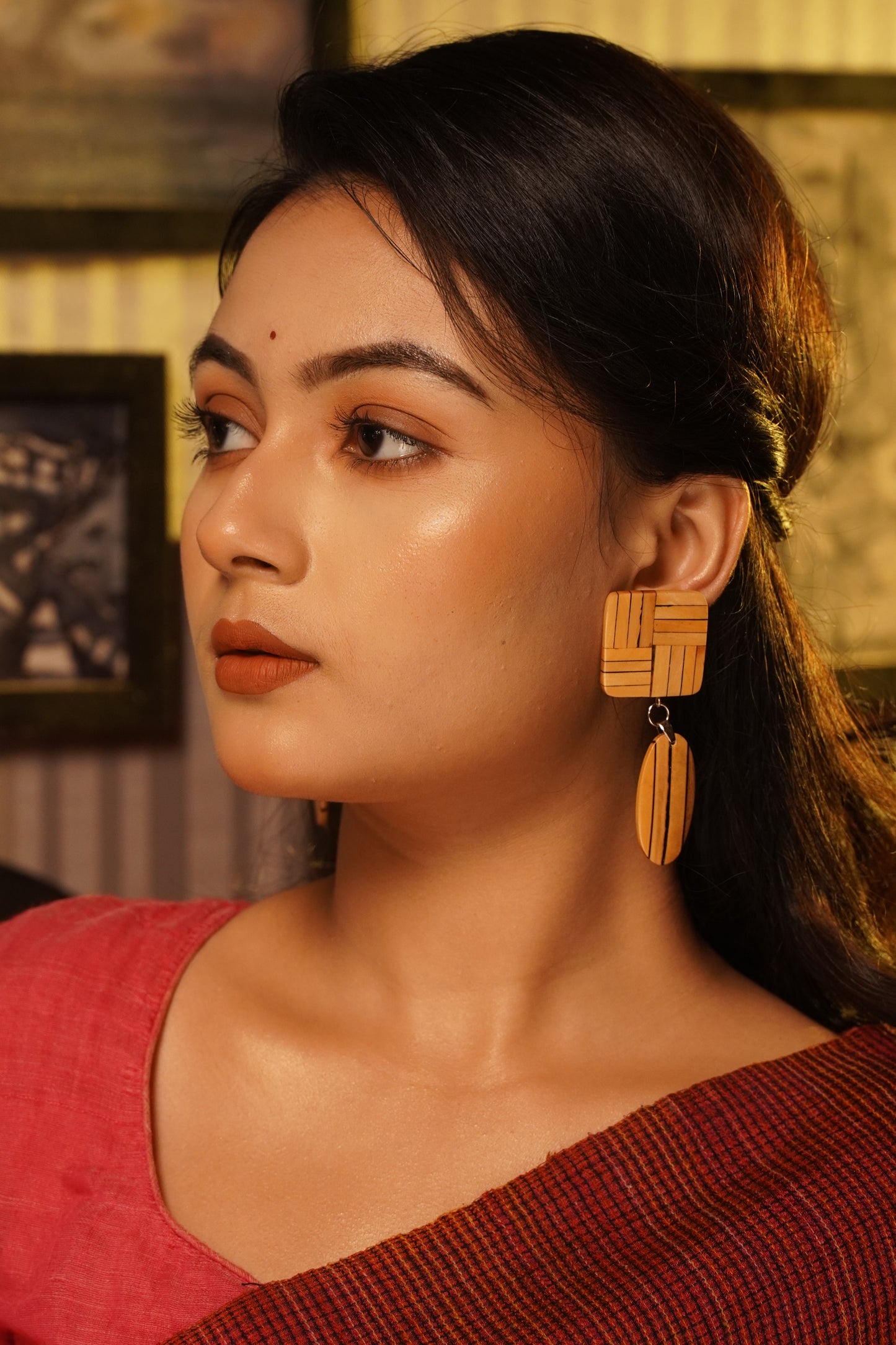
Krishna Wooden Earrings – Boxwood Panel with Woven Ebony Inlay
Krishna Wooden Earrings – Boxwood Panel with Woven Ebony Inlay
Couldn't load pickup availability
Krishna Wooden Earrings – Ebony Inlay Woven Panel Dangle Earrings
A square panel of pale Boxwood sits at the lobe, and across it run fine lines of Ebony — not all one way, but in groups set at right angles to one another, so the surface reads as woven. Below hangs a smaller oval, ruled lengthwise in the same black.
The lines are inlaid. Each is a thin strip of Ebony set into a channel cut in the Boxwood, fixed, then levelled and polished until the whole face is one continuous surface. It looks like a pattern drawn on the wood. It is not: run a fingertip across it and you feel nothing at all.
Kṛṣṇa means dark. The black is what does the drawing here, and the pale wood is simply what it draws on.
The pair weighs 10 g.
What Krishna is made from
- Upper element: Boxwood square, inlaid with Ebony lines running in alternating directions
- Lower element: Boxwood oval, inlaid with Ebony lines lengthwise
- Colour: natural Boxwood cream against natural Ebony black; no dye, stain or paint
- Findings: metal alloy hooks with a metal ring
- Weight: 10 g per pair
- Sold as: one pair
- Made in: India, from responsibly repurposed exotic hardwoods, handcrafted by skilled artisans
Why a woven pattern is the hardest inlay to cut
A single inlaid line is exacting on its own: the channel has to be cut to the exact width of the strip, or a pale seam shows alongside the black. Parallel lines add the demand of even spacing along their whole length.
Turning the direction is what makes this design difficult. Where one group of lines ends and the next begins at ninety degrees, the two sets have to meet at a clean boundary — no overrun, no gap, no line finishing a fraction short of where the next one starts. Every block edge is a place the work can fail, and there are many of them on one small panel.
It also means cutting channels both with and across the grain on the same piece of wood. A channel cut along the grain stays clean; one cut across it wants to tear at the edges. The same Boxwood behaves differently depending on which way the tool is travelling, and the finish has to look identical either way.
Inlay lasts differently from paint
Painted lines sit on top of wood and can wear, chip or lift with solvent. Inlaid lines are solid Ebony running into the piece — there is no layer to lose, because the black is not on the wood, it is the wood. In twenty years the pattern will be exactly where it is now.
How to style Krishna
- Sarees: outstanding with silk, handloom and khadi in cream, ivory, black, indigo, rust and mustard — a plain drape with a worked blouse suits it best
- Festive and wedding wear: the density of the pattern reads well at close range, which suits receptions, sangeet and evening events
- Ethnic wear: anarkalis and plain kurtas, where the square panel sits cleanly against a high or round neckline
- Work and formal wear: structured and quiet in colour, so it reads as considered rather than decorative
- Western wear: monochrome dressing, white shirts, black dresses
Wear your hair back if you can. A woven panel is a detail that rewards being seen, and it disappears entirely behind loose hair. Avoid printed or striped fabric — this piece already carries a pattern in two directions.
Caring for inlaid wood
- Put your earrings on after perfume, makeup and skincare have settled
- Remove them before bathing, swimming or exercising — moisture is the one thing that can lift an inlay over time
- Wipe gently with a soft, dry cloth after each wear
- Store in the box or pouch provided, away from moisture, heat and direct sunlight
- Handle by the metal findings rather than the inlaid faces
Boxwood is pale, so it shows marks more readily than a dark wood. Keep the pair away from oils, cosmetics and hand cream.
Related designs
- Kavita — Ebony inlay as a crossed lattice on a round disc, with a ruled oval below
- Mahek — the same inlay technique as diagonals across a Boxwood diamond
- Aadhya — an inlaid lattice disc above a joined striped teardrop, so both techniques in one pair
Shipping
Dispatched within 2–3 working days. Free shipping on prepaid orders within India; delivery is typically 2–3 days to metro cities and 5–7 days elsewhere in India. Cash on Delivery is available at selected locations with a ₹50 cash-handling charge. Krishna ships worldwide, arriving within 5–10 days of your order — import duties and local taxes are payable by the recipient.
Frequently asked questions
Are the black lines painted?
No — and this is what most people assume. Every line is a thin strip of Ebony inlaid into the Boxwood: a channel is cut, the strip is fitted into it, and the surface is levelled and polished flush. The face is completely smooth to the touch.
What is wood inlay?
The craft of setting one wood into another. A channel is cut into the base wood, a strip of a second wood is shaped to fit it exactly, fixed in place, then the whole surface is levelled and polished. The result is a pattern made of solid wood rather than applied to it.
Why is a woven inlay pattern harder than straight lines?
Because the direction changes. Where one group of lines meets another at ninety degrees, the two sets must arrive at a clean boundary with no overrun and no gap. It also means cutting channels both along and across the grain on the same piece — a channel cut along the grain stays clean, one cut across it wants to tear — and the finish has to look identical either way.
Can inlay wear off?
No. Paint sits on a surface and can rub; engraving is a cut that can fill with dust. Inlay is solid wood running into the piece, so there is nothing to lose. Keeping it dry is what protects it long-term.
Are the colours natural?
Yes. The pale is Boxwood and the black is Ebony — two different woods, not one wood in two finishes. Nothing is dyed, stained or painted.
What does Krishna mean?
Kṛṣṇa means dark. It suits a design where the black Ebony does all the drawing and the pale Boxwood is the ground it works on.
How much do they weigh?
10 g the pair — light enough for a full evening despite the size of the panel.
Can Krishna get wet?
Please avoid it. Moisture is what can loosen an inlay over years. Remove them before bathing, swimming or exercising, and if they get damp, dry immediately with a soft cloth and let them air fully.
Do pale wooden earrings mark easily?
More readily than dark ones. Boxwood is light, so keep the pair away from hand cream, oils and cosmetics, and wipe with a dry cloth after wearing.
What are the hooks made of?
Metal alloy, with a metal ring joining the two elements. If your ears react easily to metal, please write to us before ordering and we will help you decide.
Will my pair look exactly like the photographs?
The design will match. The grain of the Boxwood and the exact spacing of the inlay will differ, because the wood varies from board to board and every line is cut and fitted by hand.
What outfits suit a patterned wooden earring?
Plain fabric — cream, ivory, black, indigo, rust or mustard. Silk, handloom and khadi sarees, solid kurtas, monochrome western dressing. Prints and stripes compete with the weave and flatten it.
What if my order arrives damaged?
Write to us within 48 hours with photographs and your unboxing video. The video is required for damage, missing and wrong-item claims, so please film yourself opening the parcel.
Do you ship internationally?
Yes, worldwide, generally arriving within 5–10 days. Import duties, customs and local taxes are payable by the recipient.
Share



Krishna Wooden Earrings – Boxwood Panel with Woven Ebony Inlay
Rs. 1,399.00