
5/5 · Raj The Kalartist · 2026-09-11
Beautiful and creative
Beautiful earrings! Very creative and unique. My girlfriend loved it when I gifted her.


Chandrakalakriti
Couldn't load pickup availability
📹 Film your unboxing. Start recording before you open the parcel. We can't process a damage, missing-item or wrong-item claim without the video.
💬 Tell us within 48 hours. Send the video and photos on WhatsApp to +91 98301 50088 or by email to reachchandrakalakriti@gmail.com.
📦 We arrange the return. Reverse pickup where available, free for damaged, defective or wrong items. Items must be unused and in their original packaging.
💳 Refunds go back to your original payment method within 7–10 business days of approval. Exchanges are subject to stock.
✋ Every piece is handcrafted, so we can't accept returns for a change of mind.
A woven Boxwood panel inlaid with Ebony, carrying five strands of Ebony batons beneath it. Ten centimetres from ear to tip, and 10 g the pair.
Jhumar is the word for a chandelier, and that is exactly what this is: a broad panel at the top and a curtain of weight hanging below it, widest in the middle and tapering at the sides. It is the longest and most architectural piece we make.
The upper panel looks like four bundles of pale wood strips lapped over one another, pinwheeling around the centre — basketwork, in other words. It is not. The panel is solid Boxwood, and the dark lines that separate every strip are Ebony inlay: narrow channels cut into the pale wood, filled with strips of near-black hardwood, then sanded and polished back until both woods finish level.
The illusion works because of where the lines stop. In a real weave, a strip disappears under its neighbour and reappears on the other side. Here each run of inlay has to break exactly where the imaginary strip passes beneath, and resume exactly where it emerges — four times, at four different angles, around a square set on its point. Set one line a millimetre short and the weave stops reading as a weave.
Run a finger across the panel and you feel one continuous surface. There is nothing raised, nothing interlaced, and no join to catch.
Five strands hang from the lower edges of the panel, each carrying turned Ebony batons linked by metal rings. The middle strand falls longest and the outer ones shortest, so the group reads as a fan rather than a fringe — which is what gives Jhumar its chandelier shape and why it swings as a whole rather than tangling.
Both colours are the woods' own. Boxwood grows pale gold, Ebony near-black; nothing here is dyed, stained or painted.
Those two numbers together are the whole argument for this piece.
At 10 cm Jhumar reaches past the jawline and sits against the neck — a length usually reserved for metal. And metal at this scale is heavy: a brass or silver chandelier of the same silhouette is the kind of earring you feel by the third hour and take off before the evening ends.
The pair weighs 10 g. That is the same as a single small wooden stud, spread across a piece four times the size. The panel is thin, the batons are turned light, and the result is a full chandelier earring you can wear from a morning function through to a late night without your earlobes reminding you it is there.
Wear the hair up. This is not optional with a 10 cm chandelier — loose hair swallows the strands and the shape disappears. A bun, a low knot or a pulled-back braid lets the full fan show.
With a saree. The piece to wear with a plain drape and a plain blouse. Cream, off-white, rust, maroon, mustard, olive and black all suit it; cotton, khadi, tussar and handloom especially. Let the earrings be the jewellery.
For weddings and evening functions. A chandelier is an occasion shape. It reads clearly across a room and photographs well under low light — and at 10 g it lasts the whole function.
With western wear. An off-shoulder or wide neckline, a plain black dress, or a shirt worn open at the collar. Keep the neckline uncluttered.
No necklace. Nothing at the throat, nothing at the collarbone. A piece this long needs the space between the ear and the shoulder left empty.
Two. The upper panel is Boxwood, pale gold and close-grained, inlaid with Ebony. The hanging batons are Ebony, a dense near-black hardwood. Both are responsibly repurposed exotic wood.
No, and that is the interesting part. The panel is a single piece of solid Boxwood. The woven appearance comes from Ebony inlay — dark lines set into the pale wood in four groups running at four angles, breaking and resuming exactly where a real strip would pass under its neighbour.
Neither. They are inlay: real strips of Ebony seated into channels cut in the Boxwood, then sanded and polished until both woods sit flush. The panel is smooth and level right across.
About 10 cm in total — roughly 4 cm of panel, 5 cm of hanging strands, and the hook above.
10 g for the pair. That is the same as a single small wooden stud, spread across a piece four times the size — and it is why a 10 cm chandelier is wearable at all.
In metal they usually are. A brass or silver chandelier of this silhouette is the kind of earring you feel by the third hour. Jhumar weighs 10 g the pair, because the panel is thin and the batons are turned light — so it lasts a full function without pulling on the lobe.
It is strongly recommended. Loose hair covers the strands and the fan shape disappears, which loses most of what makes the piece worth wearing.
They are graduated — longest in the middle, shortest at the sides — so they swing as a group rather than crossing over one another. Storing the pair flat rather than loose in a box keeps them hanging straight.
Metal alloy, with metal rings linking the batons and joining the strands to the panel. If your ears react to particular metals, please write to us at reachchandrakalakriti@gmail.com before ordering and we will tell you exactly what we know rather than guess.
No. Ebony is naturally near-black and needs no treatment at all. Nothing on Jhumar is dyed, stained or painted — the contrast is simply the difference between two species.
Weddings, receptions, sangeet and mehendi functions, festive evenings and parties. It is an occasion shape rather than an everyday one, and it works best where there is room for it to be seen.
Boxwood and Ebony are both dense, close-grained hardwoods, and Ebony is among the hardest worked anywhere. The one thing to be careful with on this design is the strands — lift the pair by the hook rather than by the batons.
Take them off before showering, swimming or working out, and keep them away from sustained damp. Water is the one thing inlaid work genuinely dislikes, because two woods set together respond differently to moisture.
Gently. Boxwood warms towards a deeper honey with age and light, while Ebony holds its depth, so the contrast softens a little over the years. That is natural ageing, not fading.
Very close, but the grain will be its own. Each panel is cut from repurposed offcuts and each line of inlay is set by hand, so the figuring in the Boxwood shifts from pair to pair.
Yes — particularly as an occasion gift, since a chandelier earring is the kind of piece most people would not buy for themselves. Every pair is quality-checked and packed in premium protective packaging.
Orders are dispatched within 2–3 working days. Inside India, delivery takes 2–3 days to metro cities and 5–7 days elsewhere, and prepaid orders ship free; Cash on Delivery is available at selected locations with a ₹50 cash-handling charge. We ship worldwide, with import duties and local taxes payable by the recipient. Please film an unboxing video when your parcel arrives — if anything is damaged, defective or incorrect, tell us within 48 hours on WhatsApp at +91 98301 50088 or by email at reachchandrakalakriti@gmail.com, with the video and photographs, and we will put it right.

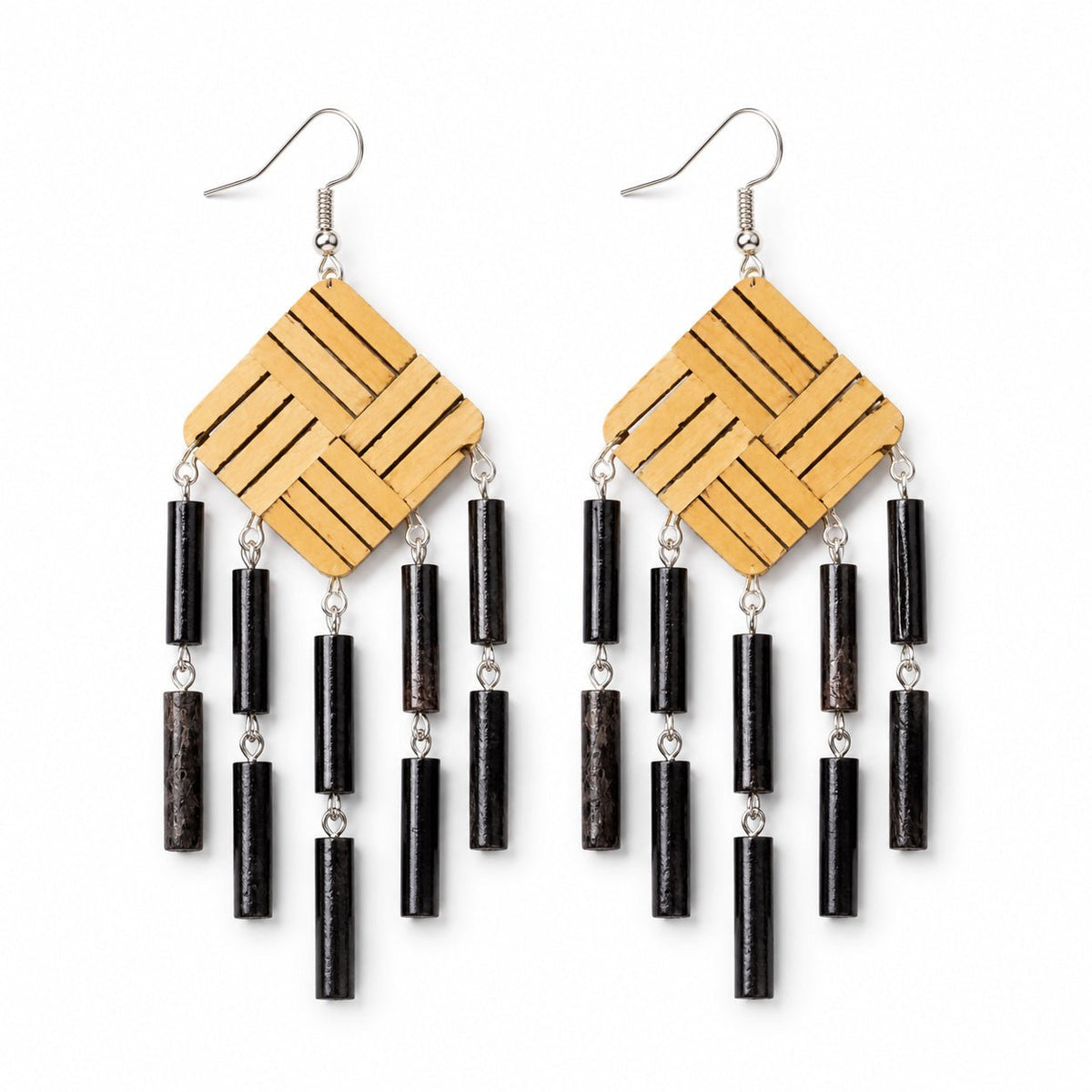
Jhumar Wooden Earrings – Ebony Inlaid Boxwood Chandelier Earrings
Rs. 750.005 out of 5 stars based on 1 review
5/5 · Raj The Kalartist · 2026-09-11
Beautiful earrings! Very creative and unique. My girlfriend loved it when I gifted her.