
Festive savings, handcrafted for you


Chandrakalakriti
Sandhya Wooden Jewellery Set – Padauk & Boxwood Bar and Half-Round Necklace with Earrings
Sandhya Wooden Jewellery Set – Padauk & Boxwood Bar and Half-Round Necklace with Earrings
Couldn't load pickup availability
🔁
Returns & Exchange
Damaged, defective or wrong item? Report it within 48 hours of delivery with an unboxing video and we'll make it right.
▾
📹 Film your unboxing. Start recording before you open the parcel. We can't process a damage, missing-item or wrong-item claim without the video.
💬 Tell us within 48 hours. Send the video and photos on WhatsApp to +91 98301 50088 or by email to reachchandrakalakriti@gmail.com.
📦 We arrange the return. Reverse pickup where available, free for damaged, defective or wrong items. Items must be unused and in their original packaging.
💳 Refunds go back to your original payment method within 7–10 business days of approval. Exchanges are subject to stock.
✋ Every piece is handcrafted, so we can't accept returns for a change of mind.
Five pieces of banded Padauk and Boxwood — an upright at each shoulder, a half-round falling from each, and one more at the centre.
Sandhya is the Sanskrit word for twilight, the hour at the other end of the day from Usha. The palette is the same because dusk and dawn are the same colours in a different order: Padauk's deep red against the pale gold of Boxwood, arriving rather than leaving.
Neither colour is dyed. Padauk is that red on its own and Boxwood that gold; every band is simply the two woods meeting.
One block, cut two ways
This is the thing worth looking at closely, and it is easiest to see on this set because both cuts are sitting next to each other.
The uprights at the shoulders and the half-rounds below them come from the same joined block — the same strips of Padauk and Boxwood, bonded edge to edge in the same order. But a rectangle cut from that block shows the bands as parallel stripes of even width all the way down. A half-round cut from it shows something else entirely: the curve crosses each band at a different angle, so the same bands taper, widen and run out at the edge.
Same wood, same joins, same order. Two completely different readings, decided purely by where the blade goes. On this necklace they are three inches apart so you can see it happen.
Joined, not printed
The bands are not a pattern applied to a surface. Separate strips of Padauk and Boxwood are bonded edge to edge, and each piece is shaped from the block afterwards — so the colour runs all the way through the wood rather than sitting on it. Cut one in half and the bands would still be there.
Each mating face has to be worked dead flat and dead square before bonding, because a joint is only as invisible as the surfaces going into it. Any gap and a hairline seam appears alongside the red.
How the necklace is built
Five pieces in all, linked with metal rings. A banded upright sits at each shoulder where the cord meets the wood, holding the line of the necklace steady. A half-round falls from each of them, angled inward. A fifth half-round sits at the centre front, broader than the two beside it, where the two sides meet.
It is an arrangement rather than a chain. Nothing repeats more than twice, so the eye reads a composition — two uprights, two falling, one resting — instead of a rhythm.
The cord is cotton thread, not leather, and it adjusts: a cotton bead slides along the thread passing through it, so you set the length yourself and it stays where you put it.
The earrings fasten with a push back
These do not hang from a hook. A banded square sits flat against the lobe on a post, secured with a push back, and a banded half-round hangs from it — the same two cuts as the necklace, in miniature.
A post holds the top element steady at the lobe and keeps the drop closer to the face than a hook would. It is also the more secure of the two fittings, which matters on a long evening.
▾Details
- Sold as: one pair of earrings and one necklace
- Woods: Padauk and Boxwood, both responsibly repurposed
- Construction: strips of Padauk and Boxwood joined edge to edge, then shaped — the bands run right through the wood
- Necklace: five pieces — a banded upright at each shoulder, a half-round falling from each, and a broader half-round at the centre, linked with metal rings
- Earrings: a banded square on a post with a push back, carrying a banded half-round below it
- Cord: cotton thread, adjustable — a sliding cotton bead sets the length
- Colour: natural wood colour, undyed and unpainted
- Findings: metal alloy posts, push backs and rings
- Earrings weight: 10 g the pair
- Made in: India, from responsibly repurposed exotic hardwoods, handcrafted by skilled artisans
Why these two woods
Padauk — African Coral Wood — comes out of the log a deep orange-red, streaked with finer darker lines that no two pieces share. Boxwood is pale gold, dense and close-grained, with almost no figure at all. One is loud and variable, the other quiet and even, and banding them puts the difference on display rather than hiding it.
Padauk deepens with light and air over the years, moving from orange-red towards a warmer, darker red. Boxwood warms in the same direction, so the pair ages together rather than apart. That is natural ageing, not fading — nothing is dyed, so there is no colour to wash out.
How to style the Sandhya set
- Sarees: handloom, khadi, tussar and cotton in cream, ivory, mustard, olive, rust and indigo; against a deep red or maroon silk the Padauk reads as part of the same family rather than a clash
- Evening functions: the composition is calmer than a full chain, which suits a reception or a dinner where the outfit is already formal
- Festive days: Durga Puja, Navratri, Diwali and daytime wedding functions — warm wood sits beside gold jewellery rather than competing with it, and it photographs without the glare metal produces indoors
- Kurtas and indo-western sets: keep the fabric solid so the banding reads; ivory, ochre, white and black all work
- Everyday: wear the earrings alone — the push back makes them quick to put on and difficult to lose
Keep the blouse plain. A worked or embroidered neckline sits exactly where the uprights and half-rounds want to be, and the two will compete. Adjust the cord shorter for a high neckline so the pieces lie flat rather than standing away from the chest.
▾Care
- Put the set on after perfume, makeup and skincare have settled — the necklace sits where perfume is usually heaviest
- Take it off before bathing, swimming or exercising. Moisture is what stresses a join over time, and cotton thread holds damp longer than wood does
- Wipe the wood gently with a soft, dry cloth after each wear. Never wash it
- Store flat in the box or pouch provided, away from moisture, heat and direct sunlight
- Handle the earrings by the post and back rather than the wood, and the necklace by the cord
▾Shipping & returns
Dispatched within 2–3 working days. Free shipping on all prepaid orders within India; delivery is typically 2–3 days to metro cities and 5–7 days elsewhere in India. Cash on Delivery is available at selected locations with a ₹50 cash-handling charge.
The Sandhya set ships worldwide, arriving within 5–10 days of your order — import duties and local taxes are payable by the recipient.
Returns within 48 hours of delivery for damaged, defective or incorrect items. Please film an unboxing video — it is required for any such claim. Message us on WhatsApp at +91 98301 50088 or email reachchandrakalakriti@gmail.com and we will arrange a free reverse pickup.
Frequently asked questions
▾What is included in the Sandhya set?
One pair of earrings and one necklace. The necklace carries five pieces; the earrings pair a banded square with a banded half-round below it.
▾What does Sandhya mean?
Twilight, in Sanskrit — the hour at the other end of the day from Usha, which means dawn. The two sets share a palette because dusk and dawn are the same colours in a different order.
▾How is Sandhya different from Usha?
Same two woods and the same joined banding, arranged differently. Usha runs eight half-rounds in a graduating chain across the whole collarbone, so it reads as a rhythm. Sandhya uses five pieces in a composition — two uprights, two falling, one at the centre — which is calmer and sits closer to the throat.
▾Why do the straight pieces and the curved ones look different if they are the same wood?
Because of where they were cut. A rectangle taken from a joined block shows the bands as parallel stripes of even width. A half-round taken from the same block meets each band at a changing angle, so the bands taper and widen as the curve crosses them. Same block, same joins — the shape decides what you see.
▾How many pieces are in the necklace?
Five, linked with metal rings — a banded upright at each shoulder, a half-round falling from each, and a broader half-round at the centre front.
▾Do the earrings have hooks or push backs?
Push backs. The banded square sits flat against the lobe on a post, and the half-round hangs from it. A post keeps the drop closer to the face than a hook would, and it is the more secure of the two fittings.
▾Which woods are used in the Sandhya set?
Two. Padauk, also called African Coral Wood, is the deep red. Boxwood is the pale gold. Both are responsibly repurposed exotic hardwoods.
▾Are the bands joined, inlaid or painted?
Joined. Separate strips of Padauk and Boxwood are bonded edge to edge and each piece is shaped from the block afterwards, so the colour runs all the way through the wood rather than sitting on the surface. Nothing is printed, painted or dyed.
▾What is the difference between joining and inlay?
Inlay cuts a channel into a solid piece and sets a strip of another wood into it, so the base stays whole and the lines can be very fine. Joining bonds separate pieces edge to edge and shapes the result as one object, giving broad bands that run right through. Both are skilled; they fail in different places — an inlay at the channel walls, a join at the seam.
▾Is the red colour natural or is the wood dyed?
Natural. Padauk is that deep red in the log and needs no treatment at all. Nothing in this set is dyed, stained or painted — the contrast is simply the difference between two species of wood.
▾Will the colour change over time?
It deepens. Padauk moves from orange-red towards a warmer, darker red with light and air over the years, and Boxwood warms in the same direction, so the two age together. That is natural ageing, not fading — there is no dye to wash out. Keeping the set out of direct sunlight slows it.
▾Is the necklace adjustable?
Yes. A cotton bead slides along the cord that passes through it, so you set the length yourself and it holds. That matters here — the five pieces need to sit at the right height to lie flat rather than stand away from the chest.
▾What is the cord made of — is it leather?
Cotton thread, not leather. The adjuster is a cotton bead as well.
▾Is the set heavy to wear?
No. The same pieces in metal or stone would be a considerable weight at the neck; in Padauk and Boxwood the scale is visual rather than physical. The earrings are 10 g the pair.
▾Will the joins come apart?
Not with ordinary wear. A properly prepared joint in dense hardwood is as strong as the surrounding wood. What stresses any join over time is moisture, which is the main reason to keep wooden jewellery dry.
▾What if it gets wet?
Dry it straight away with a soft cloth and leave it in open air before storing — the cotton cord takes longer to dry than the wood does. Brief contact is survivable; soaking, swimming and showering are not.
▾What are the findings made of?
Metal alloy — posts and push backs on the earrings, rings linking the pieces of the necklace. The wood itself is bare Padauk and Boxwood with no plating or coating. If your skin reacts easily to metal, please write to us before ordering and we will tell you exactly what we know rather than guess.
▾Can I wear the earrings without the necklace?
Yes, and the push back makes them an easy pair for an ordinary day — they go on quickly and stay where they are put. The necklace is what you add when the set is going to be the statement.
▾Does the set work with sarees?
Very well, with a plain blouse and an uncluttered neckline. The warm palette belongs with handloom, khadi, tussar and cotton in cream, mustard, olive, rust and indigo, and against deep red or maroon silk the Padauk reads as part of the same family rather than a clash.
▾Will my set look exactly like the photographs?
The design will match. The grain and the exact width of each band will not, because Padauk and Boxwood differ from board to board, and every piece is cut and fitted by hand. It is what tells you the piece is wood rather than moulded material.
Related designs
- Usha — the same woods and banding, run as eight graduating half-rounds
- Raga — a banded half-round below a plain Boxwood disc
- Rukmani — a banded Padauk drop under an Ebony square
- Aruna — Padauk on its own, shaped as a fan with no banding at all
- Sanskriti — the same joined striping, kept as a straight bar
Share


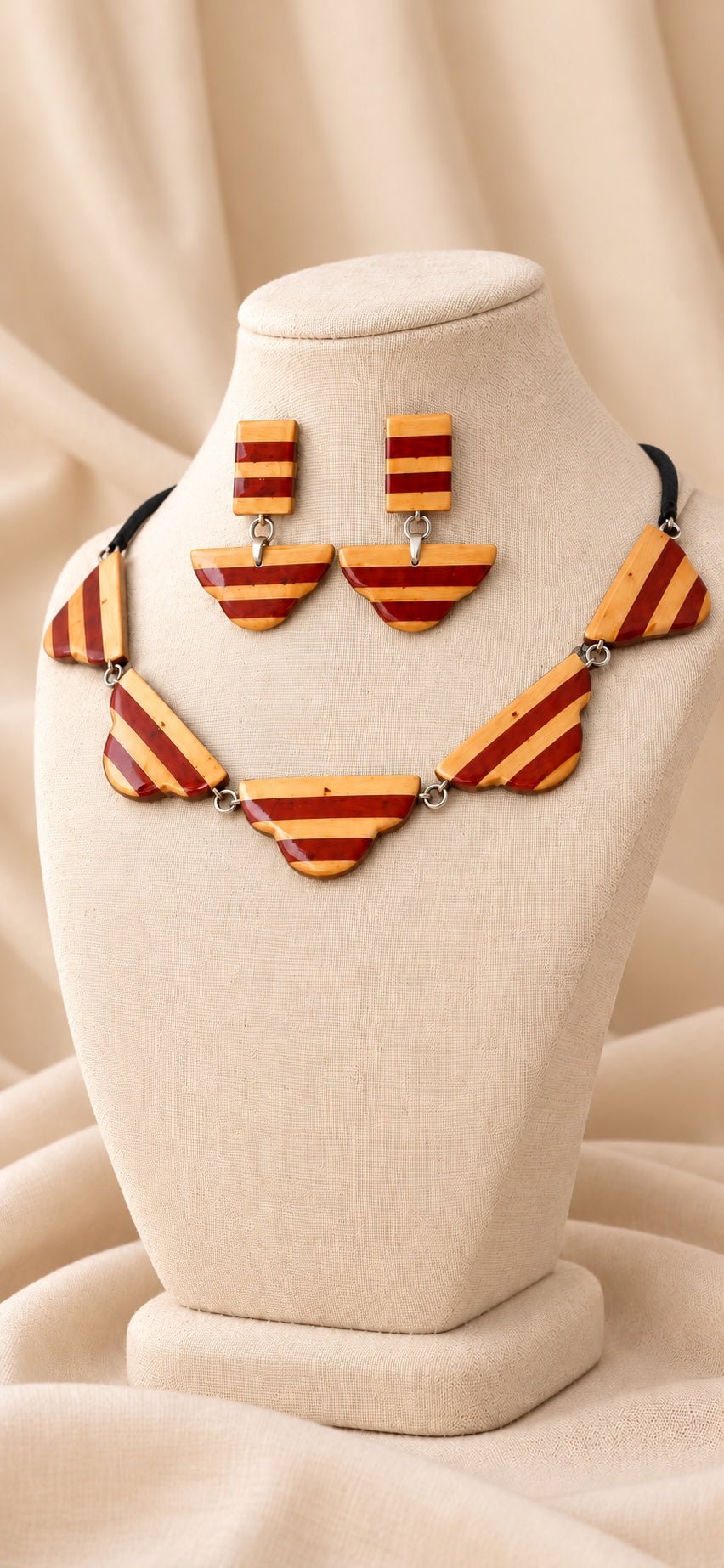
Sandhya Wooden Jewellery Set – Padauk & Boxwood Bar and Half-Round Necklace with Earrings
Rs. 2,050.00